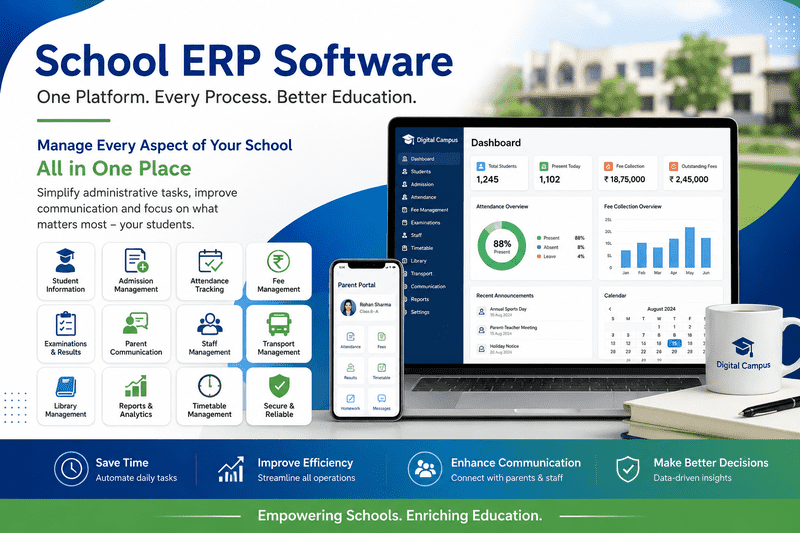
Running a school involves much more than teaching and learning. School management has to handle admissions, fees, attendance, examinations, teachers, parents, transport, communication and many other daily activities.
When these processes depend on registers, spreadsheets or separate software, managing information can become difficult and time-consuming.
This is where School ERP software can help.
What is School ERP?
A School ERP (Enterprise Resource Planning) system is an integrated software platform that helps schools manage their academic, administrative and operational activities from one place.
Instead of maintaining separate systems for admissions, fees, attendance, examinations and communication, a School ERP connects these activities through a centralized system.
In simple terms, it helps the school manage more work with less manual effort while giving management better visibility into what is happening across the institution.
Why Do Schools Need ERP Software?
As a school grows, the amount of information it handles grows rapidly.
Consider a school with even just 500 students. Every day, the school may need to manage thousands of records related to:
- Students and parents
- Admissions
- Attendance
- Fees and payments
- Examinations and results
- Teachers and staff
- Timetables
- Transport
- Library
- Parent communication
Managing all this manually can lead to paperwork, duplication of data, delays and errors.
A School ERP brings these activities together and allows authorized staff to access the information they need from a single platform.
Key Features of School ERP Software
A modern School ERP can offer a wide range of features. The exact modules may vary between schools and ERP providers.
1. Student Information Management
Maintain student profiles, parent details, academic records, documents, attendance and other information in one centralized database.
2. Online Admission Management
Manage enquiries, applications, document submission, admission status and student enrollment digitally, reducing paperwork for the admission team.
3. Fee Management
Manage fee structures, collections, concessions, receipts, outstanding fees and payment reminders. Online payment options can also make fee payment more convenient for parents.
4. Attendance Management
Teachers can record attendance digitally, while management can access attendance reports. Schools can also notify parents about student absence where required.
5. Examination and Result Management
Manage examination schedules, marks, grades, results and report cards through a centralized system. Automated calculations can also reduce manual errors.
6. Parent and Student Communication
Send important announcements, reminders and updates through channels such as mobile apps, SMS, email or parent portals, depending on the ERP.
7. Parent & Student Portal
Parents and students can access relevant information such as attendance, fees, results, timetable, assignments and school announcements.
8. Teacher and Staff Management
Maintain staff information and manage areas such as attendance, leave and other administrative records.
9. Transport Management
Schools with bus facilities can manage routes, vehicles, drivers, students, transport fees and other transportation-related information.
10. Reports and Management Dashboard
Management can view important information through reports and dashboards covering areas such as admissions, attendance, fees, student strength and academic performance.
Benefits of School ERP for Management
The value of an ERP is not simply the number of features it provides. Its real value comes from connecting different school processes.
- Better Management Visibility
School owners and management can get a clearer picture of school operations without waiting for multiple departments to prepare separate reports.
- Less Manual Work
Routine activities such as data entry, fee reminders, report preparation and communication can be automated.
- Better Data Accuracy
A centralized database reduces duplicate records and the possibility of errors caused by maintaining information in multiple places.
- Faster Communication
Important information can reach parents, students and teachers more quickly through digital communication channels.
- Improved Parent Experience
Parents can access fees, attendance, results, announcements and other information without having to contact the school office for every routine requirement.
- Better Decision-Making
Management can use real-time or regularly updated reports to identify trends and make more informed decisions.
What Should You Check Before Buying School ERP Software?
Choosing an ERP is an important decision because it becomes part of the school's daily operations.
Before selecting a provider, school management should consider:
Ease of use: Can teachers and administrative staff use it without extensive training?
Features: Does it cover the school's actual requirements?
Scalability: Can it support the school as student numbers and campuses grow?
Security: How is sensitive student, parent and staff information protected?
Integration: Can it connect with payment gateways, SMS, biometric devices or other systems used by the school?
Mobile access: Can parents, teachers and management access relevant information through mobile devices?
Support: Does the vendor provide proper implementation, training and ongoing technical support?
Total cost: Consider not only the software price but also implementation, support, integrations and other recurring costs.
Most importantly, request a live demonstration before making a decision.
Looking for a School ERP?
Digital Campus (Educational ERP) helps schools manage admissions, students, fees, attendance, examinations, communication and other school operations through an integrated digital platform.
Website: CharkhaMart.com